
Private Equity, Public Exits, and the Valuation Gap
What Happens When Companies Go Public?
Over the past decade, private equity and alternative investment funds have grown a lot. People often say that these investments are long-term strategies that will lower risk and give steady returns. They don’t change in price every day like publicly traded stocks, which can make them seem more stable.
That stability, on the other hand, is mostly structural and not economic. Recent public listings of private funds have brought to light an important issue: the difference between the value that is reported and the value that is tested in the market.
How Private Funds Are Valued
Private funds do not rely on daily trading to determine their value. Instead, they use estimates from inside the company or from outside sources to figure out a periodic net asset value (NAV). This process is normal, but it is based on guesses instead of real-time transactions.
Common valuation inputs include:
- Appraisals: Independent firms estimate what an asset might sell for under normal conditions. These appraisals are usually updated every three or six months, not all the time.
- Financial models: Today’s value is used to discount projected cash flows. The final number can be very different if you change your assumptions, like growth rates or interest rates.
- Comparable transactions: Managers look at recent sales of similar assets. If market conditions shift, those comparisons can quickly become outdated.
- Manager discretion: Fund managers usually have some leeway in how they value things. This makes it possible to make optimistic guesses, especially when performance fees are based on higher valuations.
Here’s What This Can Look Like
A private real estate fund owns office buildings and values them at $25 per share based on appraisals and rental income projections. There is no active market for the shares, so investors accept the valuation.
If that same fund lists publicly and investors become concerned about office demand or rising interest rates, buyers may only be willing to pay $15 per share. The assets didn’t change overnight—the pricing mechanism did.
Liquidity Limits and Investor Expectations
Liquidity restrictions are a core feature of private funds. They are meant to keep the fund from having to sell assets, but they also make it harder for investors to change their minds.
Typical liquidity features include:
- Quarterly redemption windows: Investors may only request withdrawals a few times per year, rather than at any time.
- Redemption caps: Funds often limit how much total capital can be withdrawn during each period, regardless of demand.
- Delays or deferrals: If too many investors request redemptions at once, payouts may be postponed to future quarters.
- Suspension rights: In stressed conditions, managers may temporarily halt redemptions altogether.
These rules are disclosed, but many investors assume they will never apply to them personally.
Here’s What This Can Look Like
An investor wants to use the money from a private fund to buy a house in two years. When the market gets worse, a lot of investors want to take their money out at the same time. The fund sticks to its redemption cap, which means that only a part of the requested funds can be taken out. The investor gets less cash than they thought and has to wait a few more quarters for the rest.
Why Liquidity Pressure Changes Everything
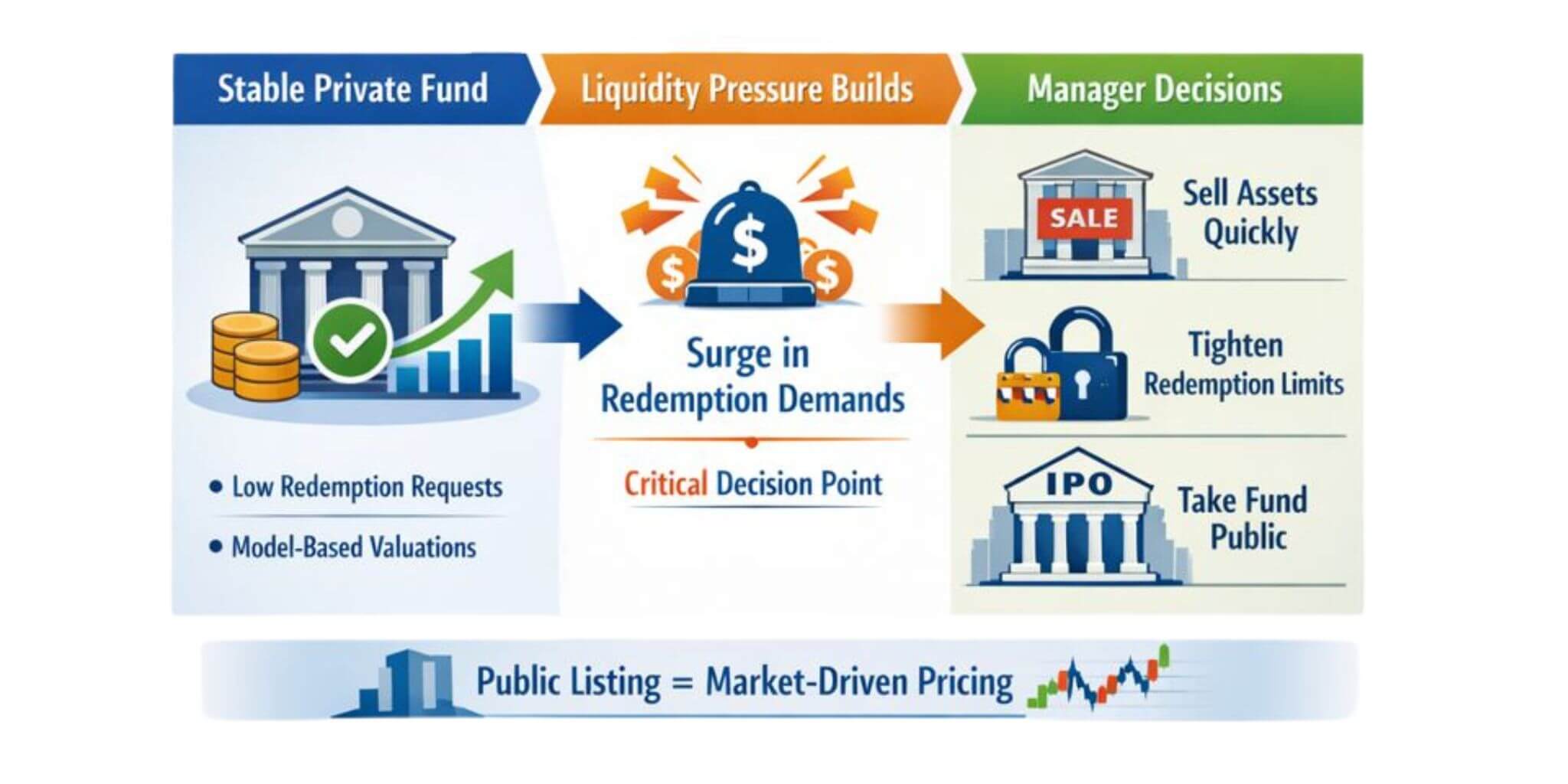
As long as redemption requests remain within manageable limits, private funds can preserve stable, model-based valuations. The challenge begins when liquidity demands outpace what the fund can reasonably support.
At that inflection point, fund managers are forced into difficult trade-offs:
- Rapid asset sales → often at discounted prices
- Stricter redemption limits → increasing investor frustration
- Pursuing a public listing → to unlock broader liquidity
Once a fund goes public, valuation control fundamentally shifts. Pricing is no longer determined by internal models but by real-time market forces.
From Modeled Value to Market Price
Once shares begin trading publicly, valuation moves from theory to reality:
- Prices are always being tested in real time.
- Market participants—not models—set value
- Investors who were previously locked in can now get their money back and leave.
This shift often exposes whether prior valuations were conservative, optimistic, or no longer aligned with market conditions.
Key Takeaway
Private fund valuations are not inherently wrong, but they are conditional. They depend on limited liquidity, stable assumptions, and investor patience. When those conditions change, pricing can change quickly as well.
Understanding how valuations are created—and how liquidity constraints work—helps investors better assess the risks before a public exit forces the issue.