Strong Dollar vs. Weak Dollar: Who Actually Benefits?
Why A Strong Dollar vs. A Weak Dollar Isn’t Just an Economic Debate
When discussions about the U.S. dollar dominate headlines, the conversation often sounds technical—exchange rates, trade balances, currency indexes. But behind those charts is a more important question:
Who benefits from a weak dollar—and who doesn’t?
A strong dollar and a weak dollar each create winners and losers. The impact is not evenly distributed. Some sectors thrive when the dollar declines. Others feel immediate financial pressure.
Understanding this divide is critical—especially in an environment where inflation already strains household budgets.
What Does “Strong” or “Weak” Dollar Really Mean?
A strong dollar means the U.S. currency has higher purchasing power relative to other currencies. Americans can buy more foreign goods for fewer dollars.
A weak dollar means the opposite. It takes more dollars to buy foreign goods, and the dollar’s global purchasing power declines.
Importantly, currency strength does not automatically equal economic strength. As explained in the previous article, Is the U.S. Dollar Losing Value by Design?, currency policy often reflects trade-offs.
Exporters vs. Consumers: The First Divide
One of the most cited arguments for a weaker dollar is export competitiveness.
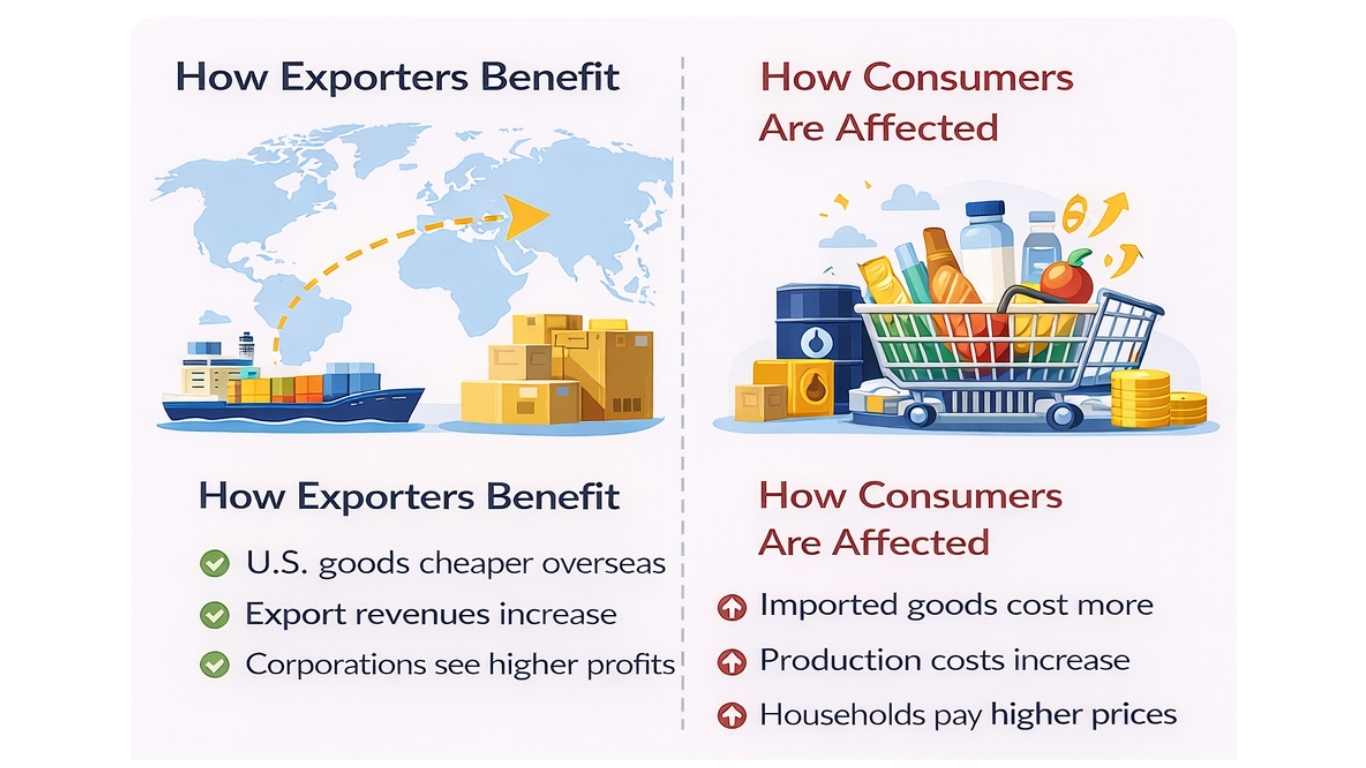
How Exporters Benefit
When the dollar weakens:
- U.S. goods become cheaper for foreign buyers
- American products are more competitive overseas
- Export revenues can rise when converted back into dollars
Large multinational corporations often benefit from this dynamic. If a company earns revenue in euros, yen, or other currencies, converting those earnings into a weaker dollar can boost reported profits.
From a corporate earnings perspective, this can look positive.
How Consumers Are Affected
However, the same mechanism works in reverse for imports.
The United States imports:
- Consumer goods
- Electronics
- Raw materials
- Energy components
- Industrial inputs
When the dollar weakens:
- Imported goods become more expensive
- Input costs rise
- Businesses pass costs along to consumers
Households that rely heavily on imported goods—or goods made with imported materials—feel the impact quickly. Grocery bills, home improvement materials, appliances, and everyday items can all rise in price.
This is why consumers often sense inflation before it shows up clearly in broad economic data.
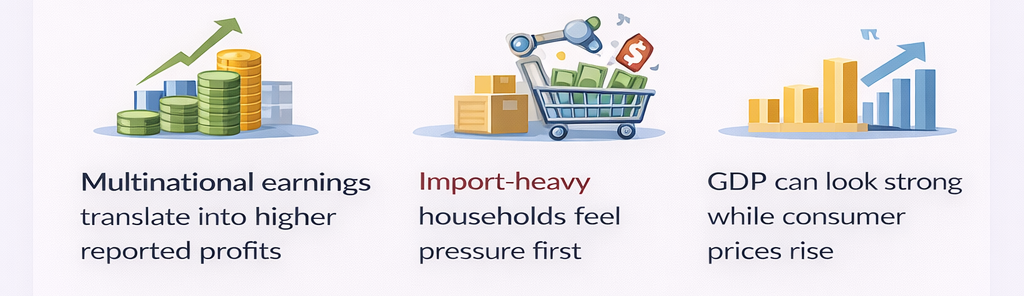
Why GDP Can Look Strong While Consumer Prices Rise
Gross Domestic Product (GDP) measures total economic output. When exports increase or corporate earnings rise—especially in a weaker dollar environment—GDP can show growth.
But GDP does not measure household purchasing power.
As exports and profits improve, the economy may appear strong on paper. At the same time, consumers may be paying more for imported goods and facing higher living costs.
The result is a disconnect: economic data can look healthy while household budgets feel tighter. A rising GDP does not automatically mean everyday families are better off.
Asset Owners vs. Wage Earners: The Second Divide
The distributional effects of a weaker dollar extend beyond trade.
Why Asset Owners Often Benefit
Assets such as:
- Real estate
- Equities
- Productive businesses
- Commodities
tend to adjust with inflation and currency devaluation. As the dollar loses purchasing power, asset prices frequently rise in nominal terms.
This does not mean assets are immune to volatility. Markets fluctuate. However, over long periods, asset values often reflect inflationary pressures and currency decline.
In inflationary environments, ownership tends to provide a hedge against purchasing power erosion. This reinforces the broader theme explored in How Inflation Quietly Taxes Your Money: inflation and currency devaluation quietly reward ownership over idle dollars.
Why Wage Earners Feel Pressure
Wages tend to adjust more slowly than asset prices. This phenomenon—often called “wage stickiness”—means:
- Cost of living rises first
- Compensation adjustments lag
- Real income declines in the interim
Even when wages increase, they may not fully offset higher housing, insurance, food, and transportation costs.
Over time, this dynamic can create a widening gap between those who primarily own assets and those who primarily earn wages.
Why Businesses Might Look Like They’re Doing Well
When the dollar is weak:
- Overseas earnings translate into larger dollar amounts
- Export margins can improve
- Asset valuations may rise
Even though prices are going up, public companies can still report higher earnings in nominal terms.
This adds to the idea that “the economy is doing well,” even though many families feel like they are being squeezed.
It also explains why GDP growth and corporate profits don’t always show how people really live.
Why Households Often Bear the Hidden Costs
For households, the impact is more direct:
- Groceries cost more
- Imported goods rise in price
- Building materials become more expensive
- Insurance and housing costs escalate
Because the United States imports a significant share of goods and raw materials, currency weakness feeds directly into domestic price pressures.
This dynamic reinforces what is discussed in Why Cash Loses Value During Inflation: when purchasing power declines, the burden is felt first by consumers whose incomes do not adjust at the same pace as asset values.
Is a Weak Dollar Always Bad?
Not necessarily.
A weaker dollar can:
- Help rebalance trade
- Support domestic production in certain sectors
- Increase competitiveness in export-heavy industries
However, the benefits are concentrated. The costs are widespread.
The question is not whether a weak dollar is inherently good or bad. The real question is: Who absorbs the adjustment?
The Bigger Picture: Distribution Matters
Changes in currency policy have different effects on different parts of the economy.
- Exporters often get the first benefits
- Multinational companies might report higher profits
- Owners of assets may see their values go up
Meanwhile:
- Consumers face higher import prices
- People who work for pay have a hard time keeping up with rising costs.
- Households feel inflation before the official numbers show it.
This is why it’s more important to know how distributional effects work than to just ask if the dollar is “up” or “down.”
Key Takeaway
A dollar that is weaker can help exporters and people who own assets. A stronger dollar is good for both people who buy things and people who bring commodities into the country.
Neither of these conditions assures that everyone will succeed.
The most important thing is to understand that the strength of a currency changes the way the economy works. It changes the advantages that different sectors, ownership and labor, and corporations and households have over each other.
In a world where buying power is already under pressure, it’s no longer a choice to understand these dynamics; it’s a must.